What Is Automotive Firmware Forensics?
Automotive firmware forensics is the discipline of examining ECU firmware to detect unauthorized modifications, identify tampering evidence, and determine whether an ECU’s software has been altered from its original factory state. As vehicles become increasingly software-defined and ECU tampering becomes more sophisticated, the ability to forensically analyze ECU firmware has grown into a critical capability for insurance investigators, law enforcement, automotive manufacturers, and independent auditors.
Unlike traditional ECU reverse engineering, which seeks to understand how firmware works, automotive firmware forensics asks a different question: has this firmware been changed, and if so, how? This shift in perspective requires specific techniques for integrity verification, modification detection, and evidence preservation that go beyond standard reverse engineering methodology.
This guide covers the complete automotive firmware forensics workflow: from firmware acquisition and baseline comparison to tamper detection techniques, forensic reporting, and the regulatory landscape driving demand for these skills.
Why Automotive Firmware Forensics Matters
Several real-world scenarios drive the need for ECU firmware forensic analysis:
Insurance fraud investigation: Odometer rollback through ECU manipulation is a multi-billion dollar global problem. Forensic analysis of the instrument cluster ECU and engine control module can reveal whether mileage values have been altered, even when the displayed value appears consistent.
Emissions compliance verification: After the Dieselgate scandal, regulators and testing authorities need tools to verify that ECU calibration data matches approved type-approval values. Automotive firmware forensics can detect unauthorized emissions calibration modifications, also known as “delete” tunes, that remove DPF, EGR, or SCR functionality.
Warranty claim validation: Manufacturers investigate whether aftermarket ECU modifications contributed to mechanical failures. Forensic firmware analysis determines whether the ECU was tuned, when the modification occurred (in some cases), and whether the modification could have caused the reported failure.
Accident reconstruction: In accident investigations, the ECU firmware and its stored data (freeze frame data, crash event logs) provide evidence about vehicle behavior before impact. Automotive firmware forensics ensures this data has not been tampered with after the incident.
Vehicle pre-purchase inspection: Used vehicle buyers and dealers increasingly seek firmware verification to confirm that high-value vehicles have not been modified. A forensic firmware check can reveal hidden modifications that traditional mechanical inspection would miss.
Firmware Acquisition for Forensic Analysis
The first step in automotive firmware forensics is obtaining the firmware in a forensically sound manner. This means preserving the original data without modification and maintaining a clear chain of custody.
Forensic Acquisition Principles
- Write-blocking: Use read-only methods whenever possible. JTAG and BDM reads are inherently non-destructive. OBD-based reads using ReadMemoryByAddress (UDS 0x23) do not modify the firmware. Avoid any method that requires writing to the ECU during the extraction process.
- Hash verification: Calculate SHA-256 hashes of the extracted firmware immediately after acquisition. Repeat the extraction and verify that both copies produce identical hashes, confirming a clean read.
- Documentation: Record the ECU part number, hardware version, vehicle VIN, date, extraction method, and tool used. Photograph the ECU and any physical seals or security labels before and after the process.
- Chain of custody: Maintain a signed log of who handled the ECU, when, and what procedures were performed. This is essential if the findings may be used in legal proceedings.
For detailed information on firmware extraction techniques, see our ECU Firmware Extraction Methods guide. The key difference in forensic work is the emphasis on non-destructive methods and documentation.
Baseline Comparison: The Foundation of Tamper Detection
The most reliable method for detecting ECU modification is comparing the acquired firmware against a known-good baseline. This baseline comparison is the cornerstone of automotive firmware forensics.
Obtaining Baseline Firmware
OEM firmware databases: Some manufacturers provide access to original firmware through their dealer diagnostic systems (ODIS for VW, ISTA for BMW, Techstream for Toyota). A forensic examiner can download the correct original firmware version for the target ECU’s part number and compare it against the extracted firmware.
Reference ECU extraction: When OEM databases are not accessible, extracting firmware from a known-unmodified ECU of the same type provides a reference. This requires verifying that the reference unit itself is original.
Firmware header analysis: ECU firmware contains version information, software part numbers, and calibration identifiers in header structures. Comparing these identifiers against the manufacturer’s published software catalog reveals whether the firmware version is legitimate or has been replaced with a non-standard version.
Binary Comparison Techniques
Full binary diff: A byte-by-byte comparison between the target and baseline firmware highlights every difference. In a clean (unmodified) ECU, the only differences should be in adaptation data areas (learned values that change during normal operation). Modifications to code sections, calibration maps, or checksum regions indicate tampering.
Section-level analysis: ECU firmware is organized into distinct sections: bootloader, application software (ASW), calibration data, and adaptation/coding area. Automotive firmware forensics examines each section separately. The bootloader and ASW sections should be byte-identical to the baseline. Calibration data differences indicate either an OEM update or aftermarket modification.
Entropy analysis: Modified firmware regions often show different entropy characteristics than original code. Encrypted or compressed aftermarket patches may have higher entropy than the surrounding original firmware, making them visible through statistical analysis.
Tamper Detection Techniques
When a baseline is not available, or when you need to confirm findings beyond simple comparison, these techniques detect modification evidence directly from the firmware.
Checksum Verification
ECU firmware contains integrity checksums that cover specific memory regions. The manufacturer calculates these checksums during production, and the ECU verifies them during boot. If the firmware has been modified but the checksums have been correctly recalculated (as any competent tuner would do), the checksums alone will not reveal tampering. However, if the modification tool failed to update all checksums, or if it used an incorrect checksum algorithm, the mismatch is direct evidence of tampering.
Calibration Map Analysis
Experienced forensic examiners can identify modified calibration maps by comparing values against known physical limits and engineering constraints. Fuel injection quantities exceeding the injector’s physical flow capacity, boost pressure targets above the turbocharger’s design limit, or disabled sensor plausibility checks all indicate aftermarket calibration modification.
This analysis requires deep knowledge of the ECU platform. For Bosch MED17/EDC17 systems, our technical guide provides the platform knowledge needed to evaluate calibration data validity.
DTC and Diagnostic Handler Modification
A common aftermarket modification is disabling specific Diagnostic Trouble Codes (DTCs) to suppress warning lights after hardware removal (DPF delete, EGR delete, catalytic converter removal). Forensic analysis can detect this by examining the DTC configuration tables in the firmware. Disabled DTCs that should be active for the vehicle’s hardware configuration indicate tampering.
Code Pattern Analysis
Aftermarket tuning tools often leave identifiable patterns in the firmware. Some tools write a signature string or identifier into unused memory areas. Others use characteristic patch patterns, such as replacing conditional branch instructions with NOP (no operation) instructions to bypass specific checks. Recognizing these patterns is a specialized skill developed through experience with multiple tuning tool families.
Need professional ECU forensic analysis? Our team conducts automotive firmware forensics for insurance companies, legal proceedings, and manufacturer warranty investigations. Learn about our ECU reverse engineering services.
Immobilizer and Security System Forensics
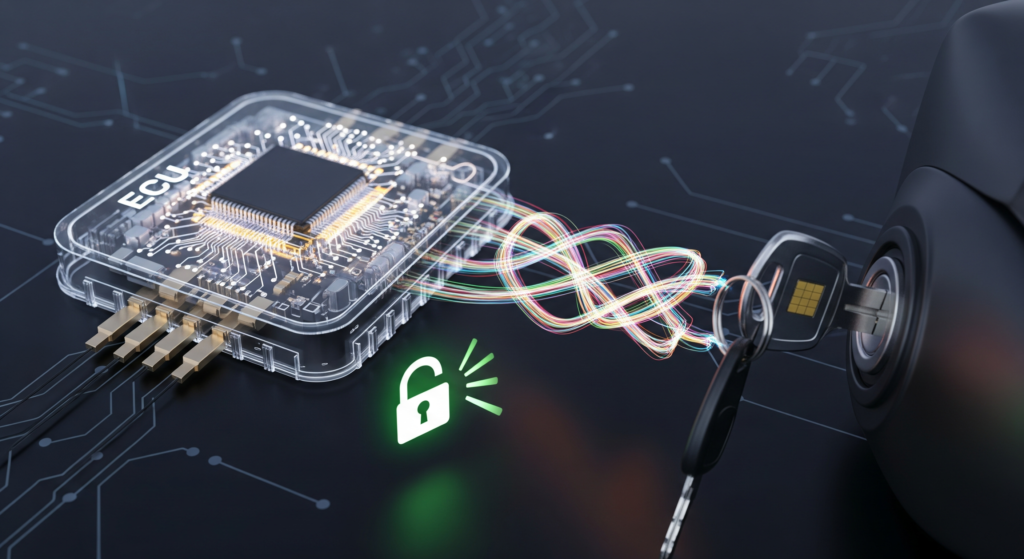
Beyond engine calibration, automotive firmware forensics extends to the vehicle’s security systems. The immobilizer ECU, instrument cluster, and body control module store critical security data that may be targeted for manipulation.
Key count verification: The immobilizer module tracks how many keys are programmed to the vehicle. An unexpected increase in key count may indicate unauthorized key programming, possibly for theft preparation.
VIN consistency check: The VIN is stored in multiple ECUs throughout the vehicle. A mismatch between VIN values across different modules suggests either ECU replacement or deliberate VIN tampering (common in stolen vehicle laundering).
ISN and Component Security analysis: The cryptographic handshake between the engine ECU and immobilizer module uses stored secret values. Modifications to these values, detected through comparison with immobilizer data extraction, indicate that the immobilizer system has been reprogrammed.
Forensic Reporting and Legal Considerations
Automotive firmware forensics often produces evidence for legal proceedings, insurance claims, or regulatory compliance actions. The forensic report must be clear, defensible, and understandable to non-technical audiences.
Report structure for automotive firmware forensics:
- Executive summary: Clear statement of findings in non-technical language.
- Scope and methodology: What was examined, what tools and methods were used, and what standards were followed.
- Chain of custody: Complete handling documentation from ECU receipt to analysis completion.
- Technical findings: Detailed description of each modification detected, supported by binary comparisons, screenshots, and hash values.
- Interpretation: What the modifications mean in practical terms (performance tuning, emissions defeat, odometer manipulation, etc.).
- Conclusion: Professional opinion on whether the firmware has been modified from its original state.
Need a forensic ECU examination? Our team provides documented, defensible automotive firmware forensics reports. Contact us to discuss your case.
The Regulatory Landscape
ECU forensic analysis is becoming increasingly relevant due to evolving regulations:
UNECE WP.29 (R155/R156): These regulations require vehicle manufacturers to implement cybersecurity management systems and software update management systems. Compliance verification may require forensic analysis of ECU software integrity.
EU Type Approval (Anti-Tampering): European regulations increasingly require manufacturers to implement anti-tampering measures for emissions-related ECU software. Forensic analysis tools and methods are needed to verify compliance and detect violations.
Right to Repair vs Security: The tension between vehicle owner access rights and manufacturer security creates a complex landscape where forensic analysis must distinguish between legitimate owner modifications and unauthorized tampering that affects safety or emissions.

This discipline sits at the intersection of reverse engineering, digital forensics, and automotive engineering. As vehicles become more software-dependent and ECU modifications become more common, the demand for professionals who can forensically examine ECU firmware will continue to grow. Insurance companies, legal teams, regulators, and manufacturers all need reliable answers to the question: has this ECU been modified?
The techniques covered in this guide, from forensic acquisition and baseline comparison to calibration analysis and code pattern detection, provide a comprehensive framework for answering that question. Combined with deep platform knowledge from our guides on advanced firmware reverse engineering and CAN bus analysis, these forensic skills enable thorough, defensible ECU examination results.
Let's Work Together
Need Professional Assistance with Reverse Engineering or Cybersecurity Solutions? Our Team is Ready To Help You Tackle Complex Technical Challenges.