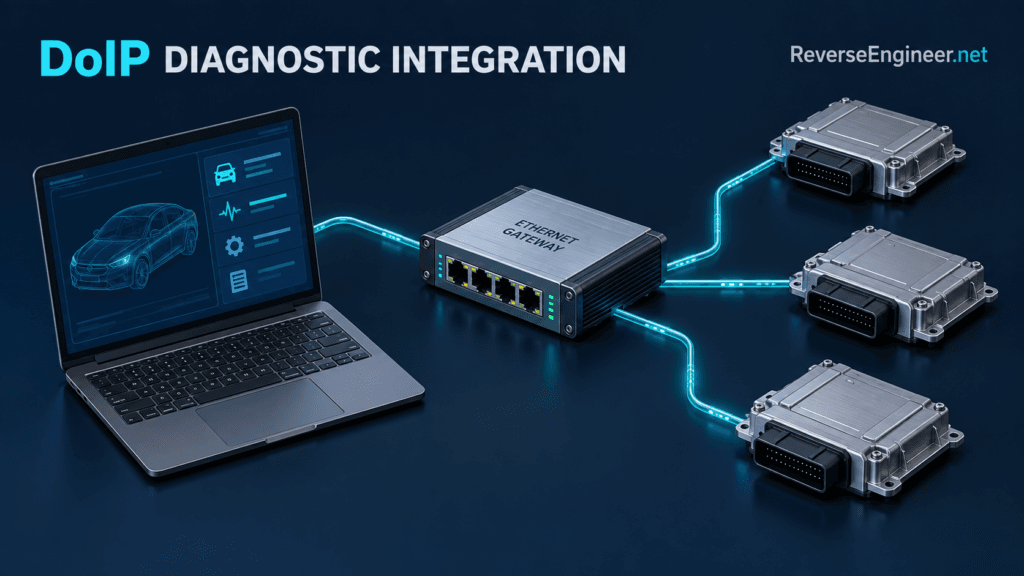
A diagnostic tool discovers a vehicle gateway and establishes a network connection, yet the intended ECU operation still fails. For teams building workshop equipment, automated test stations or engineering tools, this is where DoIP diagnostic integration becomes a system analysis project.
Reliable integration requires an understanding of the transport, the gateway’s routing behaviour and the controller’s diagnostic state. Reverse engineering helps fill the gaps when implementation details or diagnostic descriptions are incomplete.
Connectivity is one part of the diagnostic workflow
Diagnostics over Internet Protocol provides a transport for diagnostic communication. Softing’s DoIP overview and communication sequence distinguish vehicle identification, routing activation and diagnostic exchanges. Those stages help structure an investigation, while the target implementation determines the details that matter to a particular tool.
A gateway may be reachable even when a downstream ECU is unavailable. A routing request may succeed while a diagnostic service is rejected. A tool can also lose the state established by an earlier exchange when the network reconnects. Treating all of those failures as a single communications problem makes fault finding expensive.
The commercial requirement should therefore describe a complete operation. Reading a defined set of engineering data, carrying out an authorised service routine and supporting an update workflow are different integration scopes.
Build a diagnostic compatibility map
An initial investigation should record the gateway and ECU versions, logical addressing, supported operations, transport configuration and the context required to execute each operation. If a diagnostic description or supplier SDK is available, it should be evaluated before reconstructing behaviour from traffic alone.
Where information is missing, captures from a working reference tool provide evidence of sequencing and timing. Controlled comparisons between successful and failed sessions can identify where behaviour diverges. Firmware analysis may then explain a response that is ambiguous from the network recording.
Authentication and transport security are separate dependencies to document. The integration plan should use the credentials, access arrangements and interfaces available to the product team. It should not quietly assume that replacing a client removes the target’s access requirements.
Recover state, timing and error behaviour
A useful protocol specification explains more than the layout of a message. It records prerequisites, expected responses, time limits, permitted transitions and the meaning of failure. This matters when a production tool must recover gracefully instead of requiring an engineer to restart the entire session.
For example, a reference trace may contain a service request only after a particular session transition. Replaying the request alone can produce a different response. The missing information is the state relationship, not necessarily an undocumented payload field.
Timing analysis should separate network delay, gateway handling and downstream controller response. Application timeouts need to reflect the supported operation and the available evidence. Simply increasing every timeout can hide a routing fault and make the eventual tool slower to use.
Design an integration that can be maintained
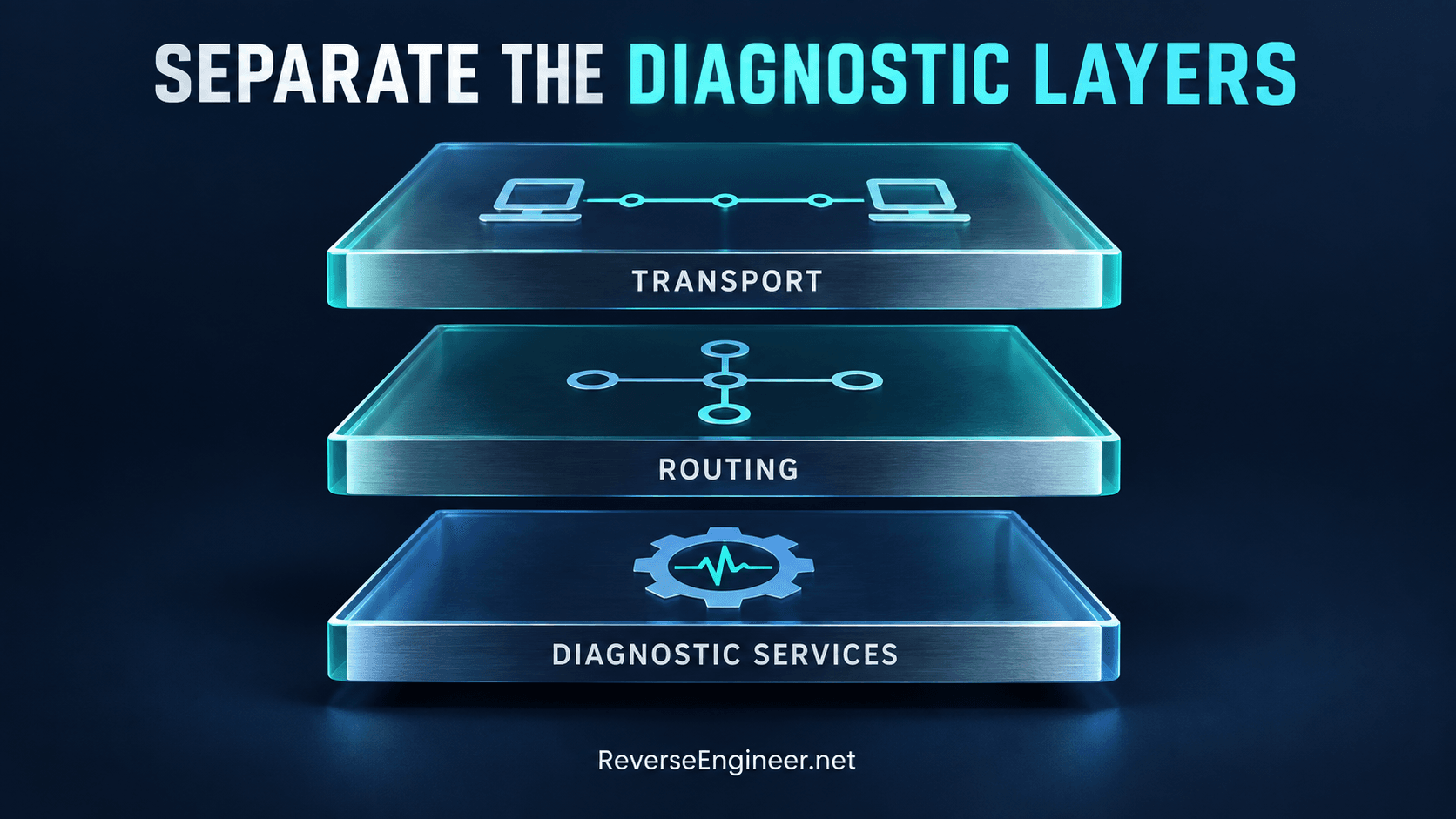
A maintainable implementation separates connection management from routing and diagnostic service logic. Hardware-specific details belong in versioned configuration where practical. The host application should receive meaningful errors rather than an undifferentiated failure code.
This separation also helps define ownership. A supplier library may handle the DoIP stack while custom work implements the controller-specific workflow. Alternatively, an existing tool may need only a narrow compatibility layer. Reverse engineering should identify the missing capability rather than automatically replacing everything around it.
| Layer | Evidence to retain | Useful deliverable |
|---|---|---|
| Transport | Connection, discovery and reconnect observations | Connection-state specification |
| Gateway routing | Addressing and routing outcomes | Target compatibility map |
| Diagnostic operation | Prerequisites, responses and failure cases | Versioned service workflow |
| Host integration | Application behaviour and error handling | Adapter interface and regression tests |
Test the sessions your customers will actually use
Acceptance testing should cover repeated connection cycles, an unavailable target, a controller reset and interrupted communication. Where several targets share a gateway, the test plan should address target selection and any supported concurrency. A reconnect should not accidentally reuse assumptions from a previous session.
Tests also need to establish the outcome of the requested diagnostic operation. A transport acknowledgement does not, on its own, confirm that the ECU completed an application-level action. Captures and functional observations should remain associated with the same test case.
A compatibility matrix should distinguish demonstrated support from untested variants. This gives a tool vendor a sound basis for release notes and avoids turning one successful integration into an unsupported claim about an entire vehicle platform.
Define the engineering handover before implementation
A DoIP reverse engineering project can produce an annotated communication model, addressing and session documentation, a prototype adapter and a regression corpus. A production implementation can be a subsequent deliverable with defined platform support and maintenance responsibilities.
Agree whether source, integration examples, dependency versions and automated tests are included. Also establish how diagnostic descriptions and captured data will be maintained as the target firmware changes. These details determine whether the result remains useful after the initial demonstration.
Common project questions
Is a packet capture enough to begin?
A capture can support initial analysis, especially alongside a description of the attempted operation. Reliable integration usually benefits from repeatable access to a working setup and the ability to compare controlled changes.
Can an existing diagnostic application be retained?
Often the assessment should investigate that option first. A clearly defined adapter boundary may preserve the host application’s user interface and business logic while adding the missing controller support.
Scope your diagnostic integration project
Our ECU reverse engineering services can be applied to undocumented diagnostic behaviour and tool integration. Send us your DoIP integration requirements, including the gateway and ECU references, host environment, available captures and exact operations to support. We can propose a scope built around demonstrable compatibility and the needs of the resulting tool.
Let's Work Together
Working on an ECU, a firmware image, or a board? Send what you have.