A controller reaches end of life, a supplier changes the board, or an established product needs a new microcontroller. The existing software still has commercial value, but the replacement hardware is not an interchangeable container for the same binary. ECU firmware migration begins by establishing which behaviour must survive and which hardware assumptions must change.
For engineering teams without a complete source tree, reverse engineering can support that decision. It can recover dependencies, explain compatibility failures and define a migration specification before a replacement programme consumes substantial development effort.
The first deliverable is a compatibility decision
Consider a manufacturer supporting equipment built around an unavailable control unit. A replacement board has a related processor and similar connectors. It may still differ in flash layout, clocking, peripheral assignments, analogue conditioning or nonvolatile data. Establishing those differences is more useful than attempting a direct transfer and interpreting the resulting failures.
The assessment should answer three questions: what can be reused, what must be adapted, and what needs to be reimplemented. A fourth question determines the budget: what evidence will demonstrate acceptable behaviour on the new target?
These decisions depend on the available artifacts. Source code, linker maps and hardware schematics enable a different project from one starting with a single firmware image and a working sample. We make that distinction at the beginning of an ECU reverse engineering engagement.
Where apparently compatible controllers diverge
| Dependency | Migration question |
|---|---|
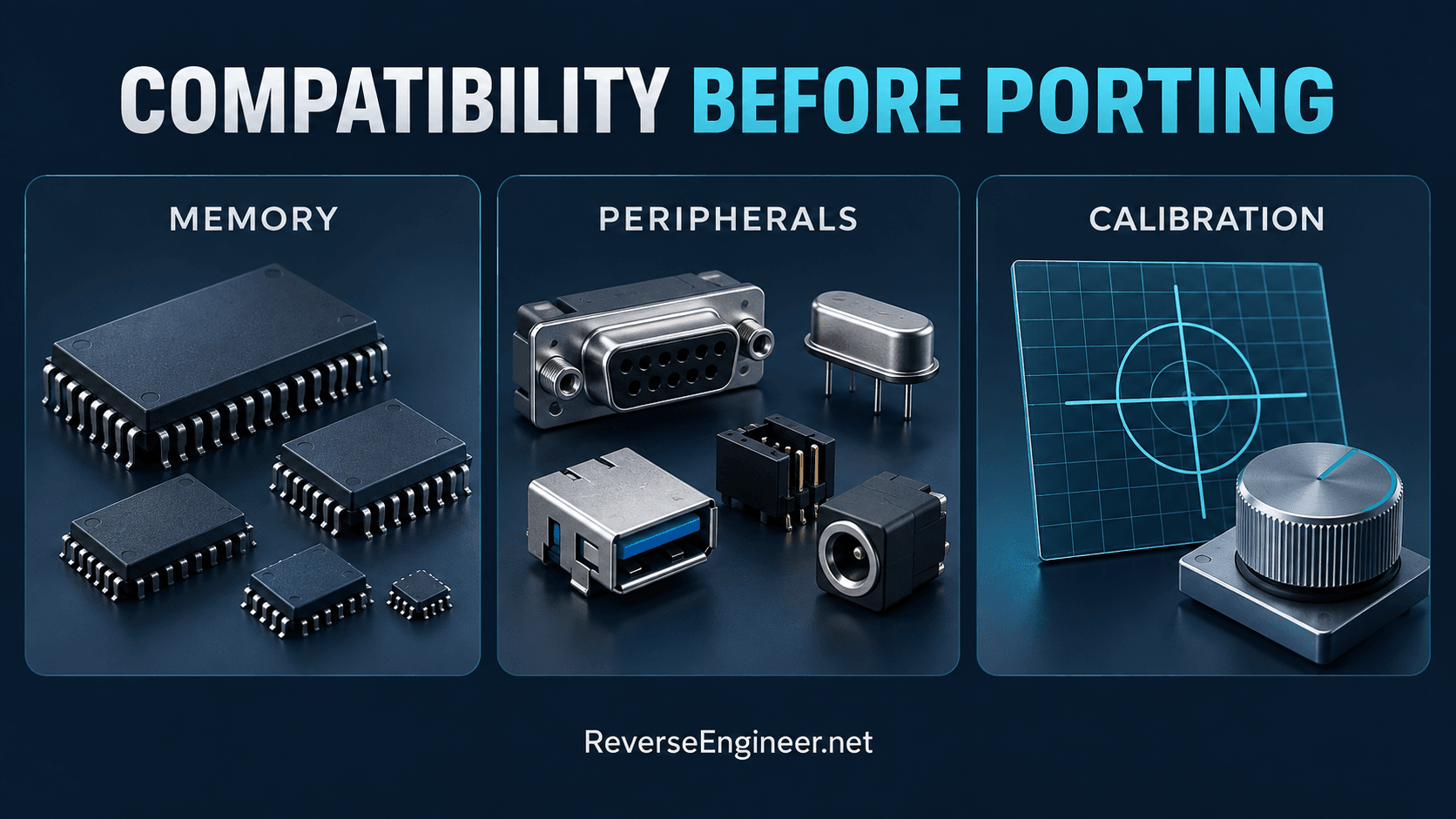
| Memory and startup | Where do code, vectors, RAM initialisation and persistent data belong on the target? |
| Peripheral behaviour | Do timers, ADC channels, communication controllers and output drivers support the expected sequence? |
| Calibration semantics | Do a table’s axes, units, limits and consumers still mean the same thing? |
| Boot and update policy | Can the intended software be installed and maintained through a supported process? |
| External interfaces | Which messages, timings and diagnostic responses must other systems continue to receive? |
Software abstraction can help when the architecture supports it. The AUTOSAR Classic Platform, for example, separates application software, the runtime environment and basic software. That published architecture provides useful context, but it does not establish that an undocumented controller follows it or that its binary is portable.
Recover the dependencies before selecting the migration route
The work starts with a versioned baseline: available images, checksums, hardware markings, reference behaviour and a record of how each artifact was obtained. Code analysis then follows the functions relevant to the agreed scope. Startup, interrupt handling, memory access and peripheral initialisation often explain why a candidate target fails before the main application is useful.
Calibration migration deserves its own review. Finding a similarly shaped table does not establish equivalence. The consuming code, scaling and surrounding limits need to agree. Persistent data also needs an explicit policy: retain, transform, reinitialise or exclude, with the consequences documented.
Behavioural observations help test those interpretations. A reference controller can be exercised through representative startup, operating, communication-loss and restart conditions. The goal is a set of reproducible expectations that a candidate implementation can be evaluated against.
Choose between adaptation, reimplementation and a replacement interface
A limited adaptation may be feasible when the architecture and hardware dependencies are well understood. It still requires integrity checks, an installation path and a defined maintenance process. Where source exists, rebuilding with an appropriate board support package may be more sustainable than editing a compiled image.
When the hardware differs substantially, recovering a behavioural specification and implementing new software may be the clearer option. Another project may preserve the original controller and develop an interface around it. The right choice follows the required product lifetime, access constraints, validation burden and ownership of the resulting work.
There is no responsible promise that every binary can be ported. A feasibility phase should be allowed to conclude that a proposed target is unsuitable. That finding can prevent a larger investment in an architecture that cannot meet the product’s requirements.
Validation should follow the product’s actual responsibilities
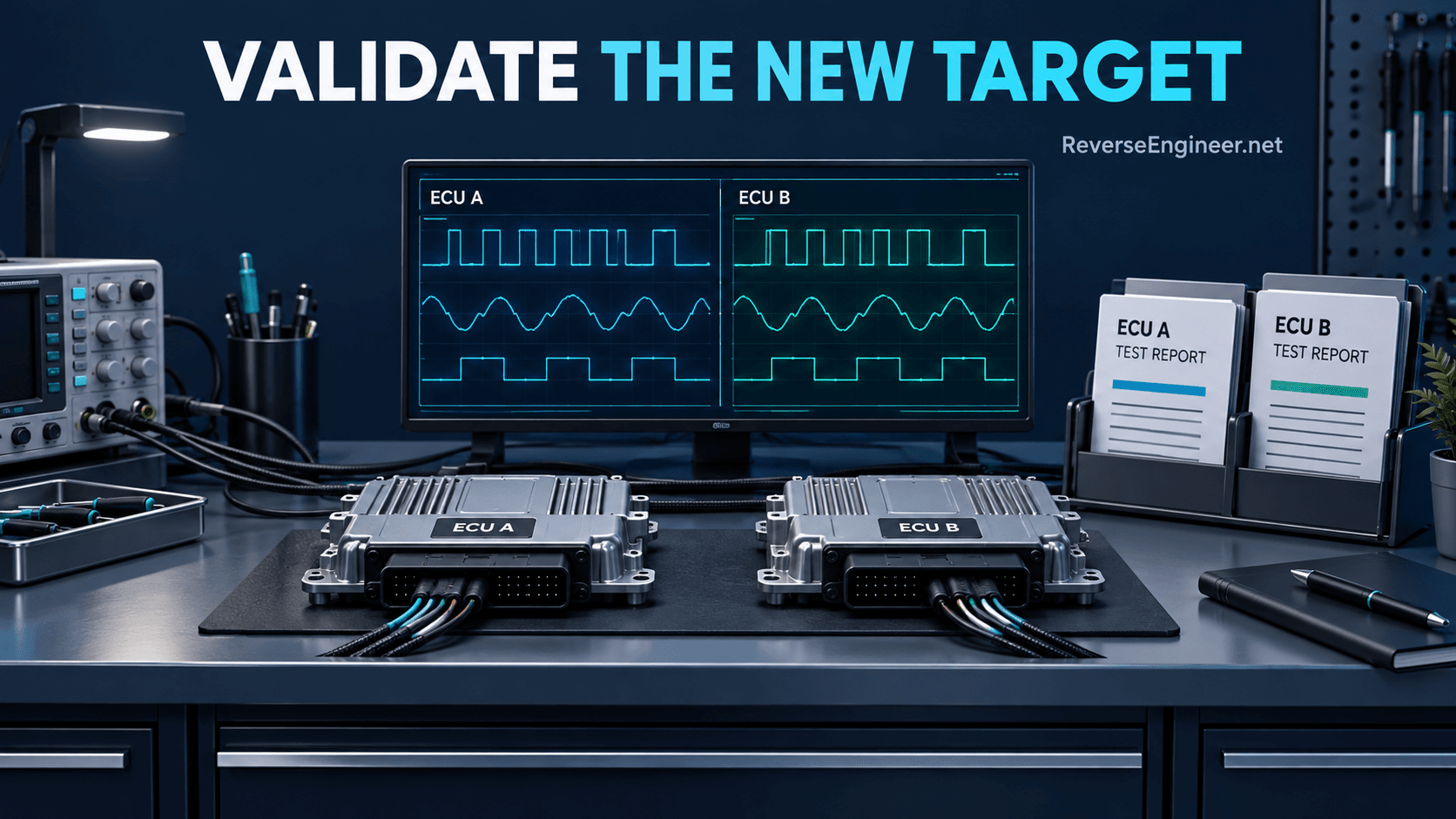
A successful boot establishes only one milestone. Communications, timing, sensor interpretation, nonvolatile storage, diagnostic access and fault behaviour need separate acceptance criteria. Tests should identify both the reference version and the candidate version, alongside the hardware configuration and relevant environmental conditions.
Where a bench model substitutes for the wider system, its limitations should be recorded. A simulated input can exercise a software decision without demonstrating the behaviour of a real actuator or validating a complete vehicle. System release decisions remain tied to the product’s intended use and validation programme.
What a well-scoped migration package contains
A useful handover includes a compatibility matrix, dependency findings, the selected migration approach and the evidence supporting it. If implementation is commissioned, the agreement should identify which source files, build instructions, configuration data, installation procedures and regression tests will be delivered.
Version support matters commercially. Supporting one known hardware/software combination is a different commitment from supporting a family of revisions. Future variants, maintenance ownership and the process for assessing subsequent changes should be agreed rather than assumed.
Questions before commissioning ECU firmware migration
Can you start without source code?
An assessment can start from binaries and hardware evidence. The achievable outcome may be a compatibility report, interface specification or replacement design plan. Original source code recovery is not an automatic consequence of decompilation.
What drives project effort?
The differences between platforms, quality of the reference material, number of behaviours to preserve and depth of validation usually matter more than image size alone. Installation restrictions and missing test equipment can change the feasible route.
Discuss your controller migration
Contact ReverseEngineer.net about ECU firmware migration with the current controller, proposed target, available source or binary files and the business reason for the change. Include the interfaces that must remain compatible and access to representative hardware. We can define an assessment around those constraints and identify the engineering work needed for a defensible migration decision.
Let's Work Together
Working on an ECU, a firmware image, or a board? Send what you have.