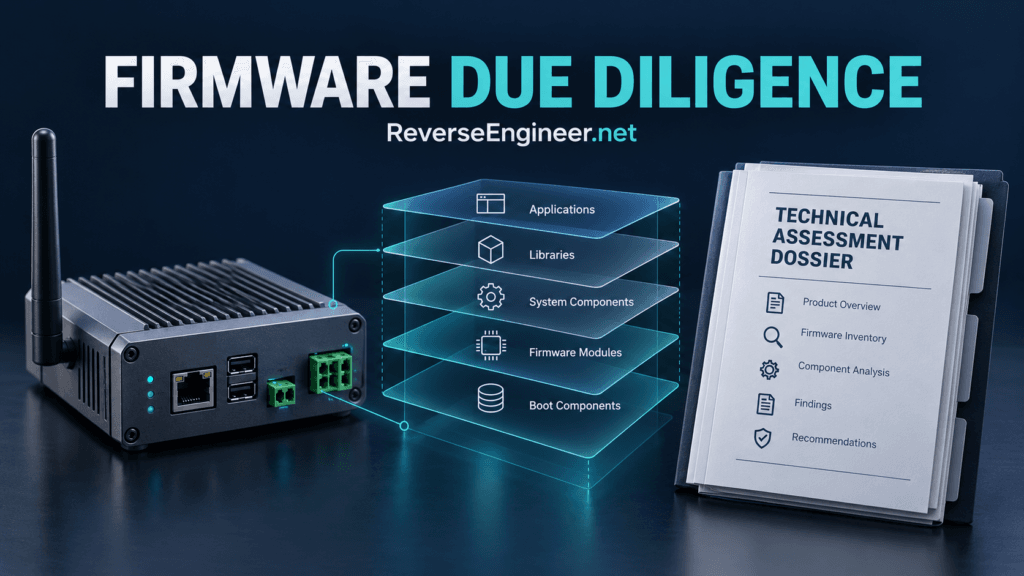
An embedded product acquisition can look straightforward until the buyer asks who can rebuild the firmware, how deployed devices receive fixes and whether the delivered binaries match the engineering records. Firmware technical due diligence examines those questions before inherited limitations become expensive product obligations.
A software bill of materials helps identify components. It cannot, on its own, establish maintainability, update ownership or the practical effort required to support the installed base. A useful review connects component evidence to the way the product is built, deployed and maintained.
Start with the decision the review must support
The priorities differ between an acquisition, a supplier selection and an internal product handover. An acquirer may need to understand engineering dependencies and integration effort. Procurement may need evidence that a supplier can support a device for the intended service life. A product owner may need to know whether one missing specialist represents a critical maintenance bottleneck.
Define those questions before requesting a large document collection. A focused evidence request reduces noise and makes gaps visible: released firmware, matching hardware, source and build information where available, update packages, component inventories and the process for producing a supported release.
Binary SBOM analysis needs confidence and provenance
Firmware analysis can identify components through metadata, file structure, signatures and other indicators. Some identifications are strong; others remain tentative, especially when libraries are statically linked, customized or stripped of useful symbols. The report should preserve that distinction instead of presenting every automated match as a verified fact.
The CycloneDX specification supports evidence associated with component identity, including analysis methods and confidence. This is a useful way to carry the basis of an identification into later review. A component inventory becomes more actionable when the reader can trace a claim to its supporting evidence.
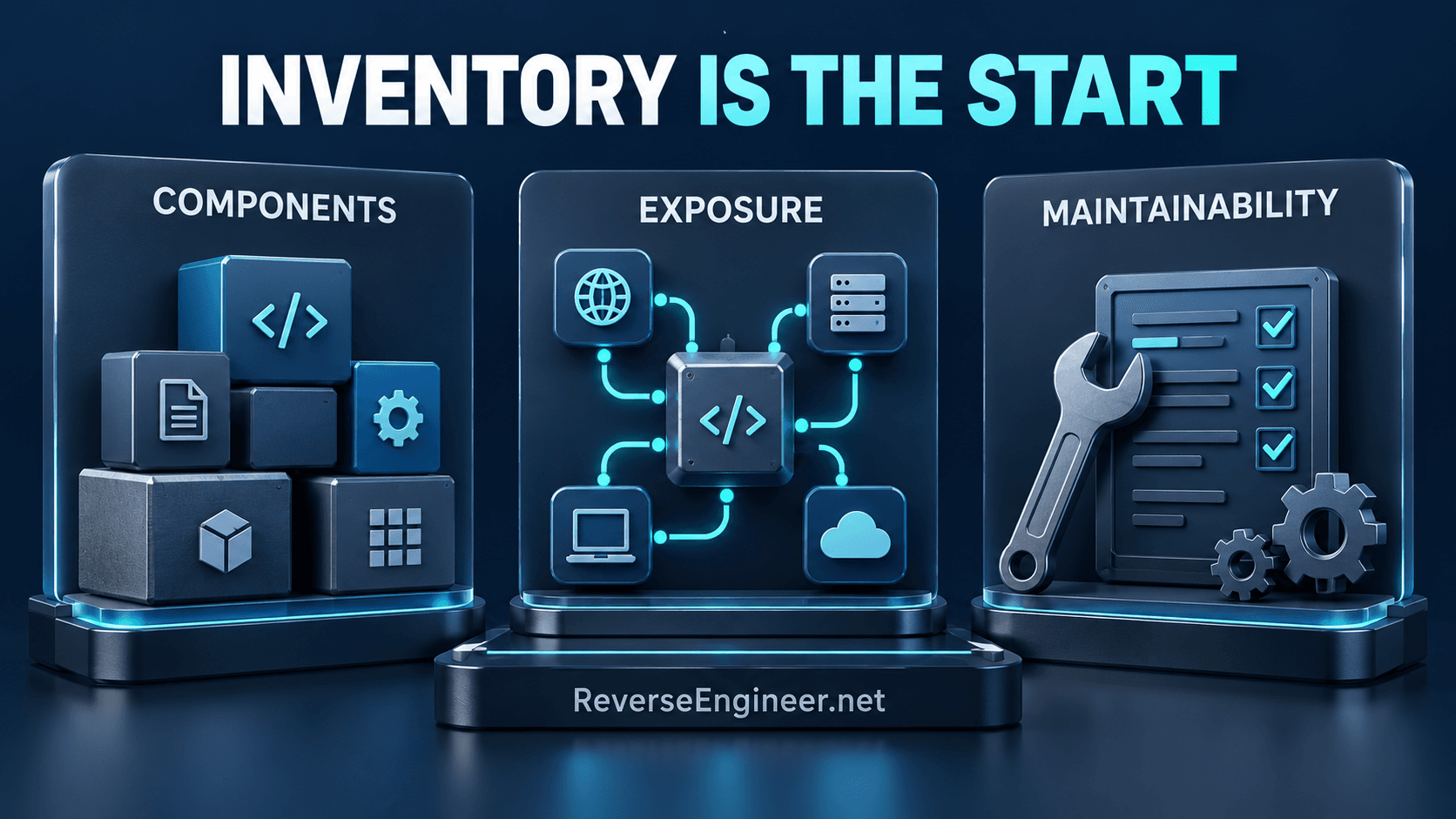
Look beyond the component list
| Review area | Business question |
|---|---|
| Released binary composition | What software is actually present in representative shipped versions? |
| Exposure and configuration | Which components and interfaces matter in the deployed product? |
| Build and release capability | Can the team reproduce and maintain a supported release? |
| Update ownership | Who can deliver an authorized fix to the installed base? |
| Hardware dependencies | Which obsolete or specialized devices constrain future changes? |
| Knowledge concentration | Which essential operations depend on undocumented expertise? |
A vulnerability list is the beginning of analysis
An identified component may have published security advisories, but matching a name and version does not fully establish the product’s exposure. Configuration, code inclusion, local modifications and reachable interfaces influence the assessment. Conversely, uncertainty about the exact version should not disappear simply because an automated scanner produced no finding.
A due diligence review should distinguish confirmed component identity, potential advisory relevance and product-specific validation. Where detailed vulnerability testing is outside the agreed scope, state what remains unresolved and how it affects the decision. This gives the buyer a usable risk register without overstating the evidence.
Test whether the product can actually be maintained
A source archive is valuable only in context. Review its relationship to released binaries, required tools, third-party dependencies and hardware-specific assets. Ask whether a representative build can be produced in a documented environment and whether differences from the released artifact are understood. Binary equality is not always available, but unexplained divergence deserves investigation.
Release capability also includes configuration data, provisioning and access to the systems that authorize updates. A team can own application source while remaining dependent on another party for an essential release step. Identify these dependencies early enough for the business to address them in its transition plan.
Choose a representative sample of the product fleet
One firmware image may not represent every supported device. Build a version and hardware matrix that includes materially different product families, bootloaders and update mechanisms. Select samples based on the decision at hand, and make the coverage explicit.
For an installed product family, examine how configuration and persistent data affect upgrades. A clean laboratory unit may not reveal compatibility issues accumulated across years of field operation. Support records and release notes can help identify migration paths that deserve deeper engineering review.
Translate engineering evidence into decisions
The executive view should identify the issues that could alter the transaction, support commitment or integration plan. The engineering appendix should preserve enough detail for those issues to be investigated and addressed. Both views should use the same evidence and clearly distinguish verified observations from estimates.
For each material dependency, record its consequence, the information still needed and a practical next step. Examples include recovering a missing build environment, validating update ownership, replacing an unsupported library or documenting a hardware interface. Avoid turning uncertainty into an invented financial estimate; quantify remediation only when the necessary scope is known.
Keep technical and commercial work connected
Technical reviewers can identify ownership dependencies and component evidence for the relevant business or legal specialists to examine. The technical report should remain precise about what was observed. A string found in a binary is an investigation lead, not a complete conclusion about contractual rights or obligations.
The review can also distinguish immediate decision blockers from improvements that fit a later engineering roadmap. This prevents a long list of low-impact observations from obscuring a small number of critical maintenance constraints.
Define a firmware due diligence engagement
A staged project can begin with an evidence inventory and representative binary review, then expand into selected build, interface or update validation. Agreed deliverables may include a component inventory with confidence notes, a product dependency map, a maintainability assessment and a prioritized list of follow-up work.
Contact ReverseEngineer.net with the product families, review purpose, available artifacts and decision deadline. Our firmware reverse engineering services can help frame a technical scope around the evidence needed for that decision, with deeper analysis reserved for the issues that materially affect the product.
Let's Work Together
Working on an ECU, a firmware image, or a board? Send what you have.