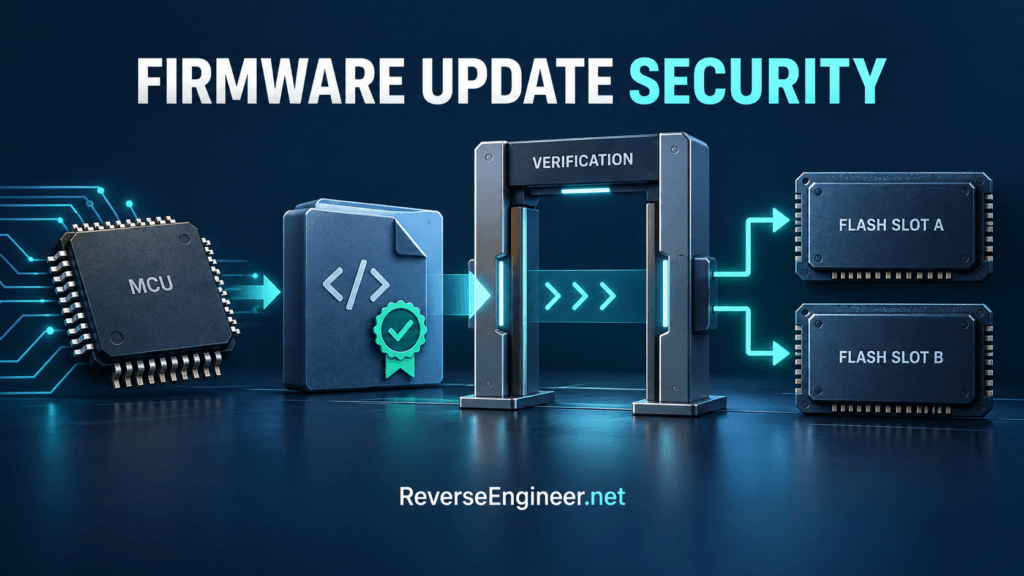
A firmware update mechanism is a product maintenance system and a trust boundary at the same time. It must accept legitimate releases, reject unauthorized software and leave the device in a defined state when an update fails. A firmware update security assessment examines how those requirements work together across boot, installation, recovery and long-term support.
For device manufacturers, the business question is concrete: can this product be updated and recovered under the conditions its owners will actually encounter? Reviewing a signature-checking function alone cannot answer that question.
Secure boot and secure updates answer different questions
Secure boot establishes whether the software selected for execution satisfies the device’s trust policy. The update process decides how a candidate image is received, checked, installed and made active. Recovery determines what happens when normal operation is unavailable. Each path needs a consistent policy, and the implementation must preserve it across transitions.
NIST’s Platform Firmware Resiliency Guidelines organize firmware resilience around protection, detection and recovery. That is a useful framework for an assessment, but referencing it does not establish certification or prove a particular product meets every requirement.
Define the trust decisions before testing them
Start by documenting the product variants, firmware components and update routes that are in scope. A field update, factory programming process and service recovery utility may reach the same memory through different software paths. An assessment should identify which paths are supported and which assumptions each one makes.
For every component, ask what authenticates it, what metadata is included in that decision and what prevents an incompatible image from becoming active. A valid signature does not, by itself, explain whether the image belongs to the correct product variant or is an acceptable version for the device’s current state.
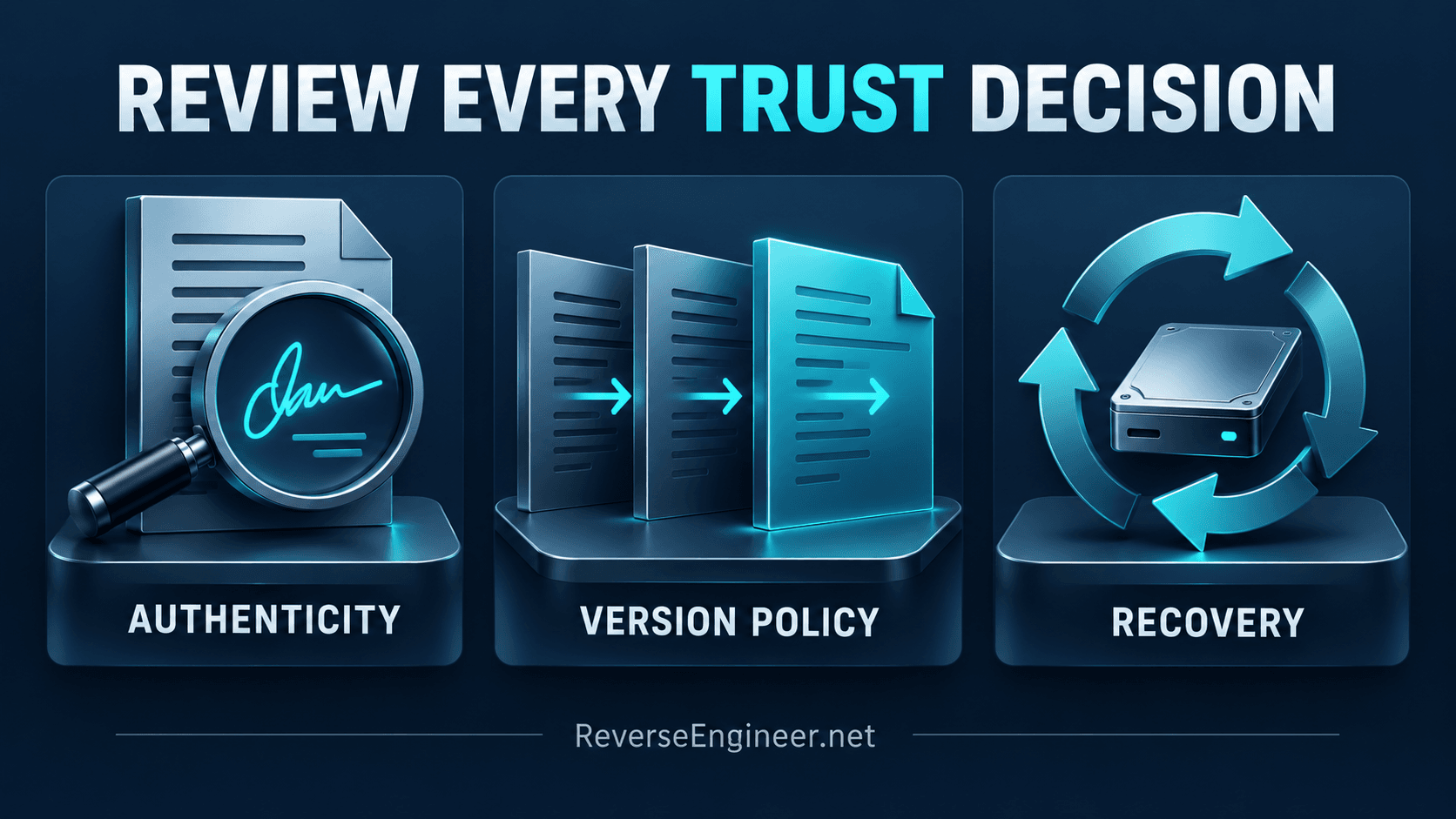
Five areas that deserve coordinated review
| Area | Assessment question |
|---|---|
| Image authenticity | Does the device validate the required content before trusting it? |
| Product compatibility | How are device family, hardware revision and component dependencies checked? |
| Version policy | Which older releases are permitted, and how is that rule retained? |
| Installation state | What remains bootable if an update stops partway through? |
| Recovery and servicing | Can authorized maintenance restore operation without undermining the intended trust policy? |
Authenticity across the complete image
Review the relationship between executable content, headers, configuration and dependency metadata. Determine which fields influence installation or execution and whether their integrity is protected by the relevant mechanism. The goal is a precise account of what the device trusts, rather than a general statement that the firmware is signed.
Rollback policy that matches the support model
A product may need controlled recovery to a previously supported release while still preventing installation of software below a security baseline. The assessment should distinguish release labels from security policy, identify where persistent decisions are stored and examine what happens during recovery or board replacement.
Reliable transitions between update states
Installation can involve staging, validation, activation and confirmation. The exact design varies by product. MCUboot’s design documentation provides a concrete example of image validation and multiple update strategies, illustrating why a review must follow the selected implementation rather than assume all bootloaders behave alike.
Use controlled negative tests, not just successful updates
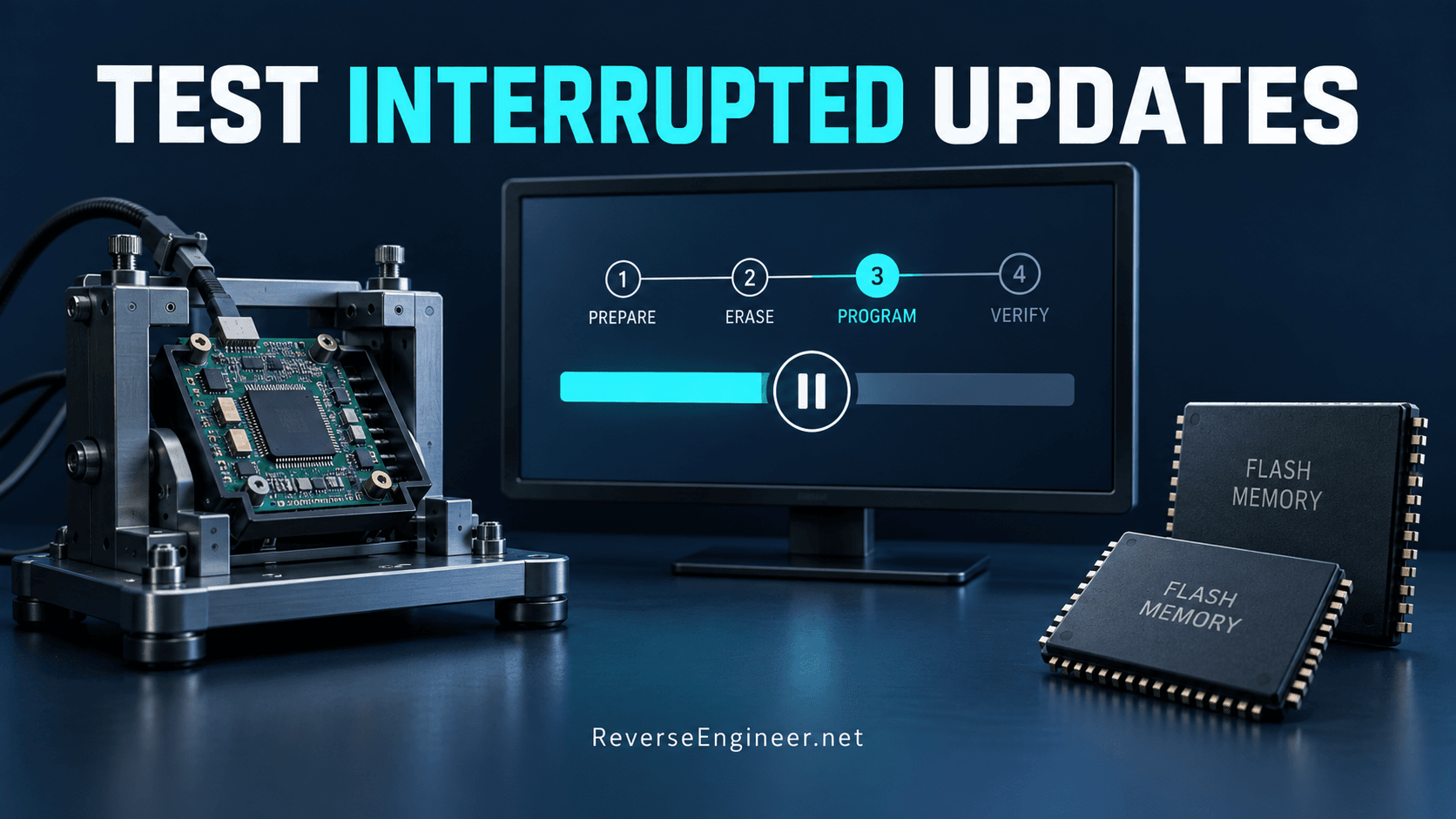
A release acceptance test should demonstrate more than installation of a valid package. Define expected handling of incompatible products, invalid packages, disallowed versions and interrupted updates. Include the persistent state and the next restart in the observation window; the failure may become visible only after the installation attempt appears to have ended.
Execute such checks on suitable development or test units with an agreed recovery plan. Record the input artifact, device configuration, expected outcome, observed outcome and supporting evidence. A reproducible finding is more useful to the engineering team than an unexplained screenshot of a failure.
Connect bootloader findings to the release process
Device-side verification is only part of the update architecture. Package creation, signing responsibility, release approval, key rotation and service tooling also affect whether the intended policy can be operated over the product’s life. An assessment should describe these dependencies even when a full review of the supporting infrastructure is a separate workstream.
For example, a technically sound validation routine may coexist with an undocumented emergency update process. The response should identify the missing engineering control and its owner. It should not assume that changing the bootloader alone resolves every operational weakness.
What an assessment should leave your team with
The central deliverable is an evidence-backed account of the update trust model, including the components and paths examined. Findings should explain the affected configuration, observed behaviour, conditions required and practical consequence. Separate confirmed results from hypotheses that need additional access or testing.
A remediation plan can then assign changes to the bootloader, package format, application, provisioning process or service workflow. Include regression tests that demonstrate the intended correction. A final retest should identify exactly which fixes and configurations were checked, rather than make a universal security claim.
What changes the scope and effort?
Multiple boot stages, separate processors, encrypted packages, hardware-backed trust decisions and several generations of deployed devices can all expand the analysis. Available source code may accelerate understanding, while binary analysis can help confirm what a released device actually runs. The most useful scope combines the evidence available with the release decision the customer needs to make.
Our firmware reverse engineering services provide a starting point for discussing an assessment tailored to the product. Deliverables and test depth should be agreed against named hardware and firmware versions.
Prepare your firmware security assessment
Send us a project overview describing the device, processor family, available update packages, supported update routes and access to test hardware. Explain whether your priority is a release decision, an architectural review or investigation of an observed failure. We can use that context to define a focused first phase and the evidence needed for deeper validation.
Let's Work Together
Working on an ECU, a firmware image, or a board? Send what you have.