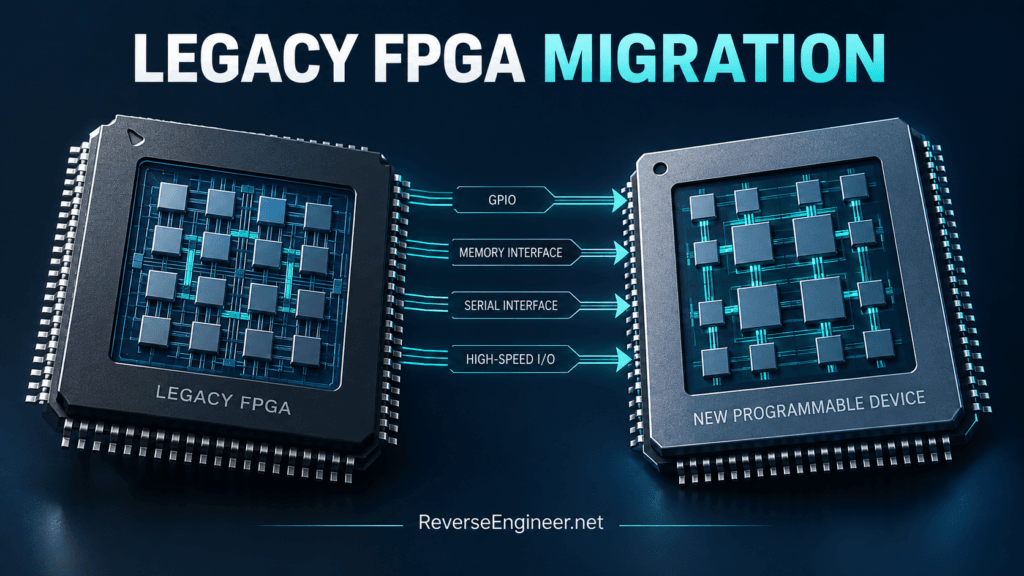
A missing FPGA design project can stop an otherwise viable product from moving to available hardware. The existing board may still work, but the RTL, timing constraints, toolchain or licensed IP needed to rebuild it may be gone. FPGA design recovery is the process of determining what evidence survives and using it to define a practical maintenance or migration route.
The central question is whether the required behaviour can be specified and verified on a replacement platform. Possession of a configuration file alone does not answer that question.
A bitstream is not a portable source project
An FPGA configuration image describes an implementation for a particular device architecture and configuration environment. It should not be treated as a ready-made design that can simply be compiled for another family. Migration also depends on interfaces, clocks, I/O standards, device resources and the surrounding board.
Protection and configuration features can further affect what can be inspected. AMD’s configuration documentation describes encryption and authentication for supported devices. The feasibility review should identify the actual device and available artifacts before promising any direct analysis of its configuration content.
Inventory the surviving engineering evidence
A project archive may contain more useful information than its owner expects: partial HDL, old synthesis reports, pin assignments, timing reports, board schematics, host drivers or a programming package. Even when the original project cannot be rebuilt, these materials can constrain the recovery problem.
Working hardware and host software are especially valuable for observing the device’s external contract. Document the board revision, configuration version and operating setup associated with each reference. If only one working unit remains, preserve it as a reference and plan the investigation around its availability.
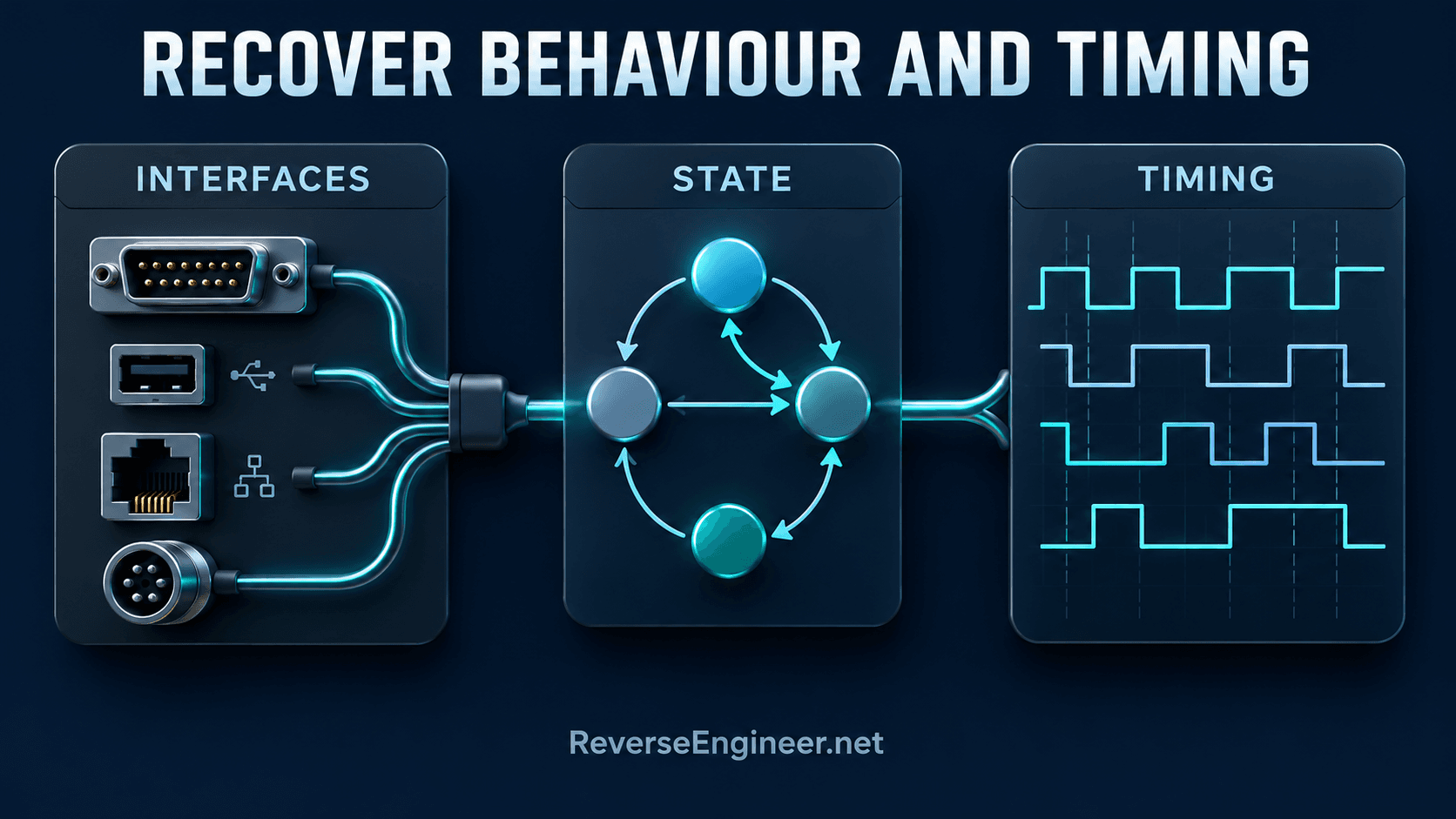
Choose between design migration and behaviour reimplementation
| Available evidence | Likely first step |
|---|---|
| Usable HDL with an outdated toolchain | Assess device primitives, constraints, IP and build reproducibility. |
| Partial design files and a working board | Reconcile the surviving logic with observed interfaces and timing. |
| Configuration artifact and working reference only | Assess inspection limits and define externally observable behaviour. |
| Incomplete artifacts and no working reference | Identify which requirements can be established from system evidence. |
These routes have different costs and confidence levels. Recovering a narrow bus interface can be a manageable scope when its behaviour is observable. Recreating a large, poorly documented signal-processing pipeline may require substantially more domain knowledge and reference data. The proposal should reflect that difference.
Recover the interface contract before the internal implementation
List the connections that matter to the system: host registers, memory transactions, serial links, interrupts and external control signals. For each interface, establish how data is represented, which operations are valid and what the surrounding equipment expects when an operation cannot complete.
Behaviour includes ordering and state. A register write may affect the next frame rather than the current one. A status flag may clear on read or require an explicit acknowledgement. These details can matter more to compatibility than the internal logic chosen for the new implementation.
Timing needs its own evidence
Functional similarity does not establish timing compatibility. The replacement must satisfy the relevant latency, clocking, reset and synchronization requirements. Identify which timing properties are specified, which are measured and which remain assumptions.
Measurements from a working unit help build a hypothesis, but they cover only the conditions exercised. A migration plan should translate recovered behaviour into explicit constraints and verification cases. Where interfaces cross clock domains or depend on external devices, the new implementation needs an appropriate engineering review of those boundaries.
Separate programmable logic from host-side dependencies
An FPGA often forms one part of a larger software and hardware system. Drivers, firmware and application software may rely on a particular register map, buffer layout or interrupt sequence. A logic redesign that changes these details can require coordinated updates elsewhere.
Make the compatibility boundary explicit. Preserving the host interface may be commercially important because it avoids replacing validated software across an installed base. Alternatively, a controlled interface change may simplify the replacement enough to justify a host update. The decision should be made at system level.
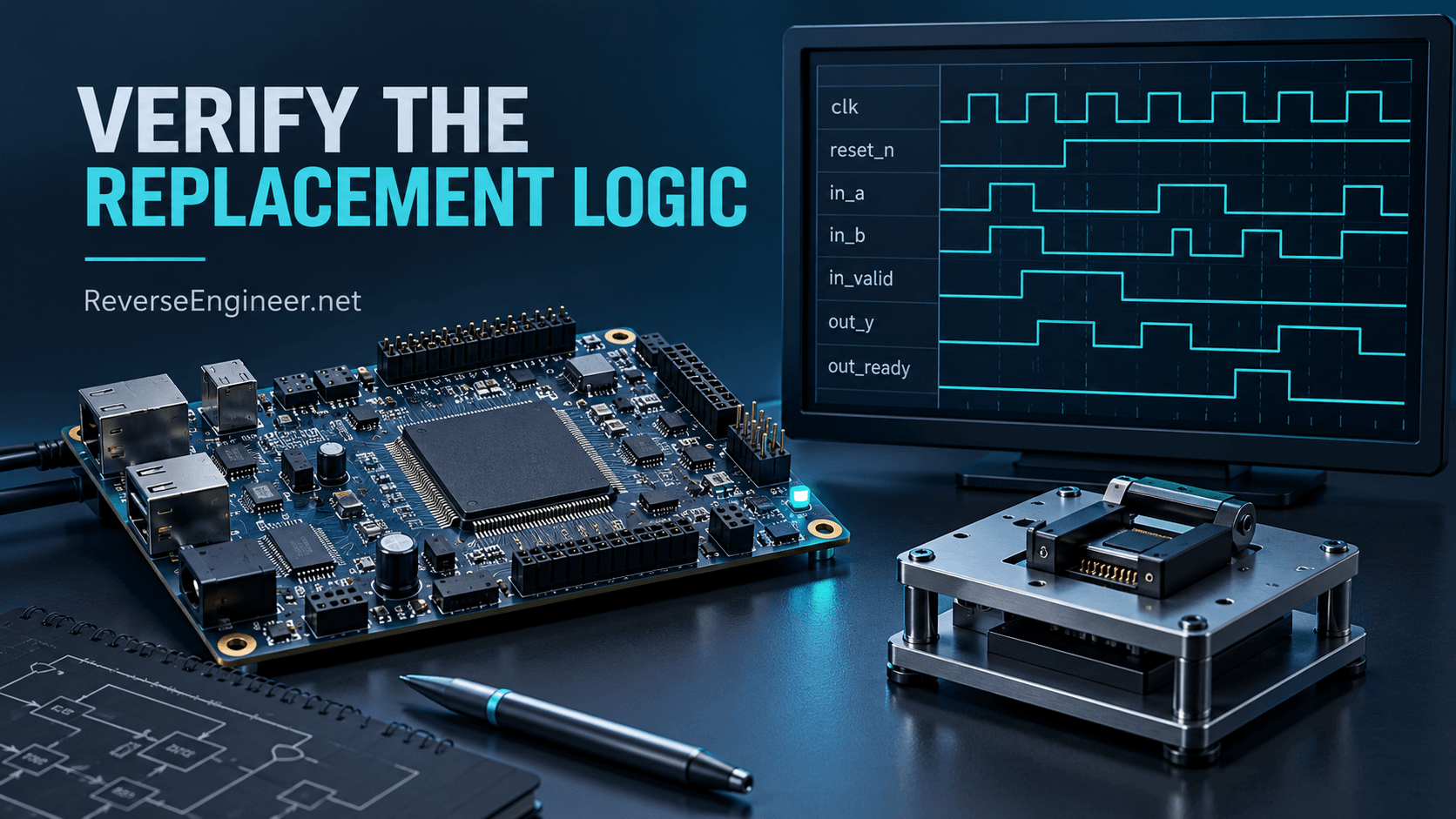
Build a verification corpus before replacing the reference
Create representative input sequences and expected observations for the functions in scope. Include initialization, normal operation, boundary conditions and recovery from invalid or interrupted transactions. Where exact output equality is inappropriate, define the permitted difference and why it is acceptable.
A useful validation sequence can combine simulation, comparison against captured behaviour and tests on the candidate board. Keep the provenance of reference data and distinguish measurements from inferred requirements. This makes disagreements easier to investigate and reduces reliance on undocumented memory of how the original device behaved.
What should a migration handover contain?
Depending on the agreed route, deliverables can include recovered interface specifications, maintained HDL, timing constraints, testbenches, build instructions and board integration notes. Identify any external IP, tool or licensing dependency the customer will need to maintain the result.
The handover should also describe coverage limits. A replacement verified for a defined operating mode should not be presented as a complete reproduction of every undocumented capability. A clear boundary makes future extension easier and protects the engineering value of the work already completed.
Use feasibility to control the investment
The first milestone should establish available evidence, major unknowns and a candidate validation strategy. It may recommend migrating recoverable source, rebuilding a limited function, changing the board architecture or gathering additional reference data before implementation. Each is a useful outcome when it prevents an unsupported commitment to a full replacement.
Discuss your FPGA recovery project with ReverseEngineer.net. Share the device family, available HDL or configuration artifacts, board documentation, host interfaces and access to working equipment. Our hardware reverse engineering services can help frame an investigation around the behaviour you need to preserve and the engineering assets required for a maintainable successor.
Let's Work Together
Working on an ECU, a firmware image, or a board? Send what you have.