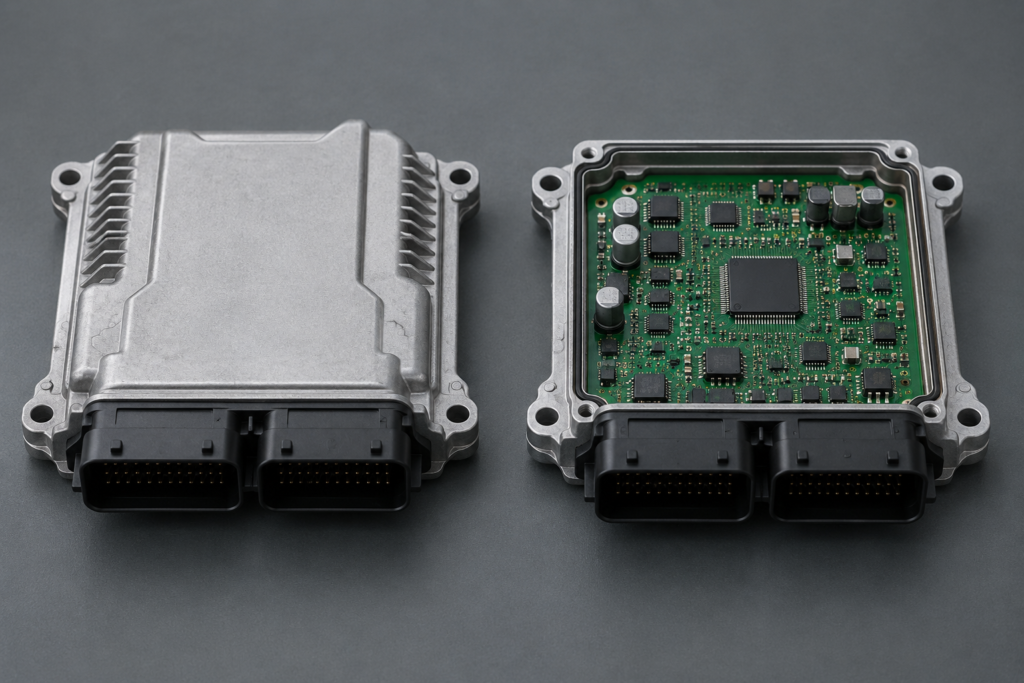
A GT86 ROM opening successfully in a calibration editor proves that the software accepted a definition. It does not prove that every displayed table belongs to the file, that its axes are correct, or that an edit will reach the intended control function. For a calibration business supporting several software revisions, an incorrect definition can spread the same error across many customer files. The commercial requirement is a versioned, evidence-backed definition—not simply a larger list of visible tables.
ReverseEngineer.net can scope definition reconstruction and validation around the functions a business needs to support. The work connects binary structure to executable code, verifies how raw values become engineering units and checks how the editor writes changes back. For first-generation GT86, BRZ and FR-S projects, the exact ROM and existing modifications must be identified before a definition from another release is treated as applicable.
A real GT86 problem: comparing files through different definitions
In a GT86 community discussion about comparing stock and modified ROMs, the owner describes confusing results when examining the files. The discussion points toward using the correct definitions for each. It is useful evidence of the practical difficulty, not proof that either binary was corrupt. An editor’s presentation can be wrong even when the underlying file is intact.
Primary project documentation reinforces the distinction. The brz-defs repository provides version-specific definitions and marks some releases incomplete or unsuitable for tune editing. Its maintainer also describes correcting address-related mistakes through additional analysis. Those published limitations show why availability is not equivalent to validation. The repository is a research source, not a blanket recommendation for writing any listed ROM.
Freeze the inputs and define the supported identity
Preserve the original binary, acquisition details, editor version and complete definition package, including inherited dependencies. Record hashes for the exact files being reviewed. A calibration ID is useful for selection, but a patched binary can retain a familiar ID while differing from the expected software. Our Toyota Denso calibration ID analysis explains why reported identity and a traceable baseline are separate questions.
The support declaration should identify what was validated: a particular binary, a known original release, or a bounded family of variants established by analysis. If the project includes modified code, that becomes part of the scope. A definition must not silently select a convenient neighboring ROM because its expected identity is missing. A rejected match is often more useful than a convincing but incorrect display.
Prove the relationship between file offsets and runtime addresses
An address in a disassembler and an offset in an exported file may refer to different coordinate systems. Establish which file regions correspond to which memory ranges before transferring locations into an editor. Headers, segmented exports and omitted regions can invalidate a simple subtraction. The mapping needs to be documented once and then applied consistently to tables, axes and code references.
Basic range checks catch a surprising class of mistakes. For a table with N elements and an element width of W bytes, the storage extent is N multiplied by W, subject to the actual layout. That extent must remain within the intended region and must not accidentally overlap an axis or unrelated object. A two-dimensional table also needs the correct dimensions and traversal order; a transposed display can look smooth while representing a different lookup.
Validate the data type before trusting the units
The same bytes can produce very different values depending on width, byte order and signedness. As a simple illustration, the byte pair 01 00 represents 256 as an unsigned big-endian 16-bit value and 1 as little-endian. This example is not a GT86 address or calibration recommendation. It demonstrates why plausible displayed numbers cannot establish a correct definition without confirming how the ECU reads those bytes.
Scaling adds another layer. A linear conversion can be expressed as physical value equals raw value multiplied by a factor, plus an offset. Validation must examine both that read conversion and the inverse used when saving an edit. Rounding, representable range and signed limits matter. A displayed value may be valid while the requested edited value cannot be represented exactly in the stored format.
Axes and lookup behavior must agree with the code
A table’s meaning depends on its inputs and the lookup routine. Determine where axis values reside, how many entries are used and whether the data is shared with other tables. Then investigate how the code selects and interpolates the table. A familiar curve shape is a useful search hint, but it does not identify the physical quantity or prove that the table participates in the target operating mode.
Code references provide stronger evidence when they connect the candidate to a known calculation or input path. Follow the value through relevant conversions and selection conditions rather than naming a table from its appearance alone. Multiple candidates may share similar values. One may be active only under a particular condition; another may be unused in the supported configuration. A professional definition should not imply that all visible candidates have equal functional confidence.
Cross-version migration requires more than an address shift
A software revision can move data while leaving behavior intact, or preserve a recognizable table while changing how it is used. These are different migration tasks. Binary similarity and function matching can identify candidates, but the destination still needs verification of dimensions, types, axes and surrounding control flow. A global offset applied to an entire definition can conceal exceptions.
The migration report should distinguish confirmed equivalents, changed functions and unresolved candidates. Where a function has been restructured, preserving an old table name may mislead the calibrator. A narrower definition with explicit coverage is more useful than apparent parity created by importing every source label. The business needs to know which editing operations are supported and which require additional reverse engineering.
Treat editor definitions and logging definitions separately
A calibration object stored in flash and a runtime variable exposed by a logger may describe related quantities without sharing an address or representation. The RomRaider project includes distinct editing and logging functionality. An engineering validation should preserve that distinction instead of assuming that a visible table value and a logged channel are direct observations of the same storage.
To correlate them, identify the relevant runtime calculation and the logger’s conversion. Filtering, clamping, adaptation and fallback logic can change the observed quantity. A mismatch between a table and a log is therefore a question to investigate, not automatic proof that the table address is wrong. Conversely, a plausible log does not validate the editor’s write conversion. Each path needs its own evidence.
Use an offline export test before hardware validation
A controlled editor test can check the definition without immediately writing an ECU. Starting from a preserved original, change a selected value in an analysis copy, save it and compare the resulting bytes. The expected storage location and encoded result should match the definition. Any additional changes need an explanation, including tool-managed checksum behavior where applicable. The output should remain separate from a file approved for hardware use.
A no-change round trip is also informative, but its interpretation depends on the tool. If opening and saving modifies the file, document why before using that workflow in production. Tests should cover meaningful boundary values and representative axis or table elements. This is not proof of correct engine behavior; it verifies that the editing operation performs the expected binary transformation.
Define hardware validation around the requested function
After structural and export checks, functional validation must address the actual requested behavior under an appropriate controlled process. The evidence may include relevant diagnostic observations, logging and a review of the code path involved. A checksum passing only establishes the corresponding integrity check; it does not validate the semantics of a calibration change. Likewise, successful programming does not prove a table definition is correct.
Acceptance criteria should state which tables and operations have been validated and which remain research candidates. The test record should identify the binary, definition revision and hardware used. If the customer needs several software revisions, validation coverage must be tracked separately. One successful test should not become an unsupported claim that every ROM sharing a prefix is covered.
A useful commercial deliverable is a maintained definition package
The package can include supported ROM identities, verified tables and axes, scaling documentation, code-reference evidence, offline export checks and a list of unresolved functions. Version control should connect each correction to the evidence that justified it. This allows a calibration company to review changes, reproduce previous work and decide whether a newly encountered ROM requires a separate assessment.
The scope should follow the customer’s paid work. A defined set of functions across several important software versions may be more valuable than broad, unverified coverage. Our ECU reverse engineering services can support that targeted reconstruction. For the broader discovery process, see ECU calibration extraction and map identification.
Request GT86 definition development or validation
Contact ReverseEngineer.net with the untouched ROM, its acquisition details, the current definition package, the editor version and the functions your team needs. Include examples of inconsistent displays or unexpected export differences. We can scope a review around an actionable outcome: verified support for specified tables on specified software versions, with documented limitations and reproducible checks.
Let's Work Together
Working on an ECU, a firmware image, or a board? Send what you have.