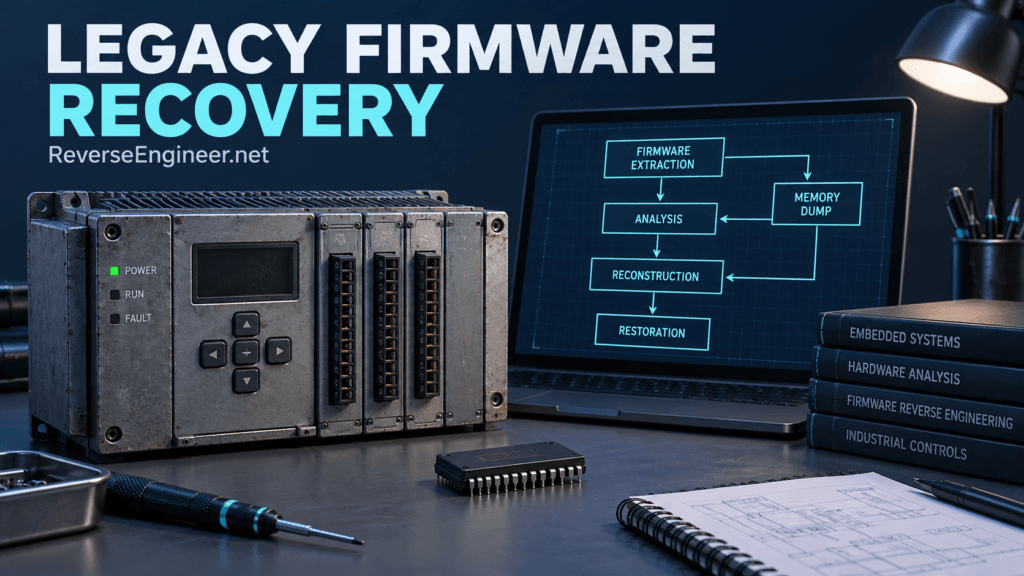
An industrial machine can remain commercially valuable long after the team that developed its controller has disappeared. When the source code, compiler project or original supplier is no longer available, a minor firmware change can become a production continuity problem. Legacy firmware recovery turns the surviving binaries, hardware and operating knowledge into a practical basis for maintenance or replacement.
The first decision is the recovery objective. Restoring an existing controller, modifying one feature and replacing the entire platform require different evidence. A well-scoped project establishes which behaviour the business must preserve before committing to extensive analysis.
When industrial firmware reverse engineering makes sense
Consider a manufacturer that still supports equipment built around an obsolete controller. It has working machines, several firmware revisions and service knowledge, but no usable development environment. Customers need replacement boards and a communication update. Recreating every internal routine would consume effort without necessarily solving either requirement.
A more focused scope might recover the communication contract, operating states, calibration interpretation and fault responses, then implement those functions on maintainable hardware. In another product, retaining the existing board and changing one isolated component may be more economical. The feasibility study should compare these routes using evidence from the actual equipment.
What can be recovered from a firmware binary?
A binary can reveal executable logic, constants, references to peripherals, protocol handling and data structures. It does not automatically reveal the original design intent, variable names or build system. Decompilation produces a representation for analysis; it is not a dependable reconstruction of the original source project. Ghidra’s official project documentation describes the disassembly and decompilation capabilities that support this kind of investigation.
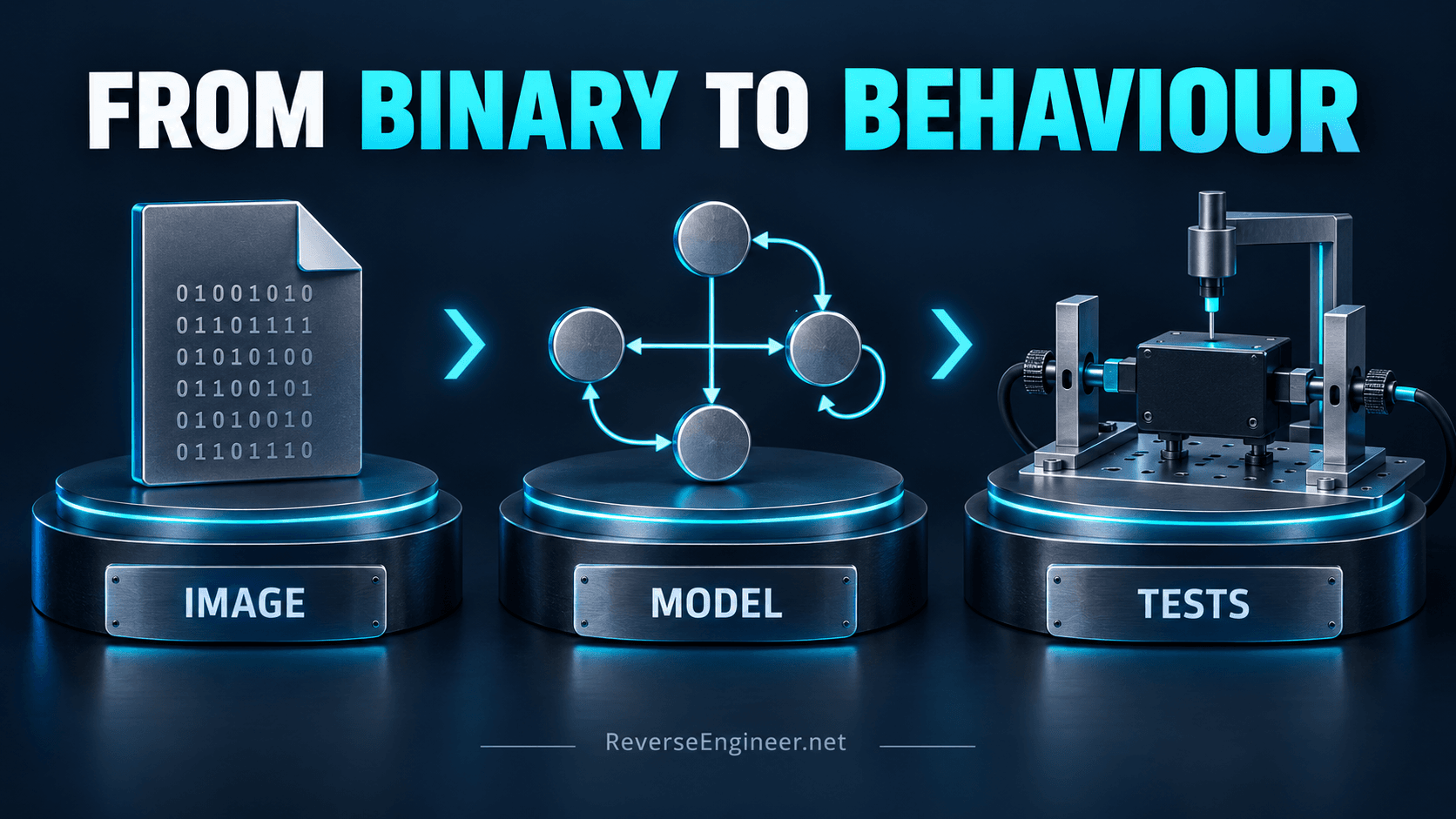
The commercially useful output is often a documented behaviour model rather than a large volume of reconstructed code. That model connects observations to decisions: which input changes a state, which configuration value selects a mode, and what happens when a sensor or external controller stops responding.
Start with a controlled reference set
Preserve the available firmware images, configuration files and nonvolatile data before investigating changes. Record the hardware revision and operating conditions associated with each sample. Two apparently identical controllers may behave differently because they contain different calibration or production settings.
Where possible, retain a known working reference and use a separate unit for controlled investigation. Capture representative normal operation, startup, shutdown and error handling. Service engineers can identify behaviours that are commercially important but poorly represented in existing documents, such as restart after an interrupted cycle or compatibility with older accessories.
| Evidence | Question it helps answer |
|---|---|
| Firmware revisions and identifiers | Which behaviours belong to which released configuration? |
| Board information and component markings | Which processor, memory and peripheral dependencies constrain recovery? |
| Communication captures | What does the controller promise to connected equipment? |
| Configuration and calibration samples | Which differences are data-driven rather than code changes? |
| Reference operating sequences | How will the replacement or modification be evaluated? |
Choose a recovery route that creates maintainable value
Targeted maintenance of the existing firmware
This route may suit a narrow compatibility issue when the hardware remains available. The work includes locating the relevant logic, understanding its callers and side effects, and establishing a repeatable validation procedure. A small binary change can still have a large verification burden if it affects scheduling, persistent data or a shared communication service.
Behaviour recovery and reimplementation
When the platform cannot be sustained, recovered requirements can support a new implementation. The scope should separate essential compatibility from incidental historical behaviour. Some quirks must remain because external equipment relies on them; others can be removed through an agreed interface change. Each decision belongs in the specification.
Interface preservation with a replacement subsystem
Sometimes only one subsystem needs replacement. A documented adapter can preserve the surrounding machine’s interface while a new controller handles the obsolete function. This reduces disruption when the wider installation is expensive to modify, but introduces its own latency, startup and fault-handling requirements.
Validate observable behaviour, including failure modes
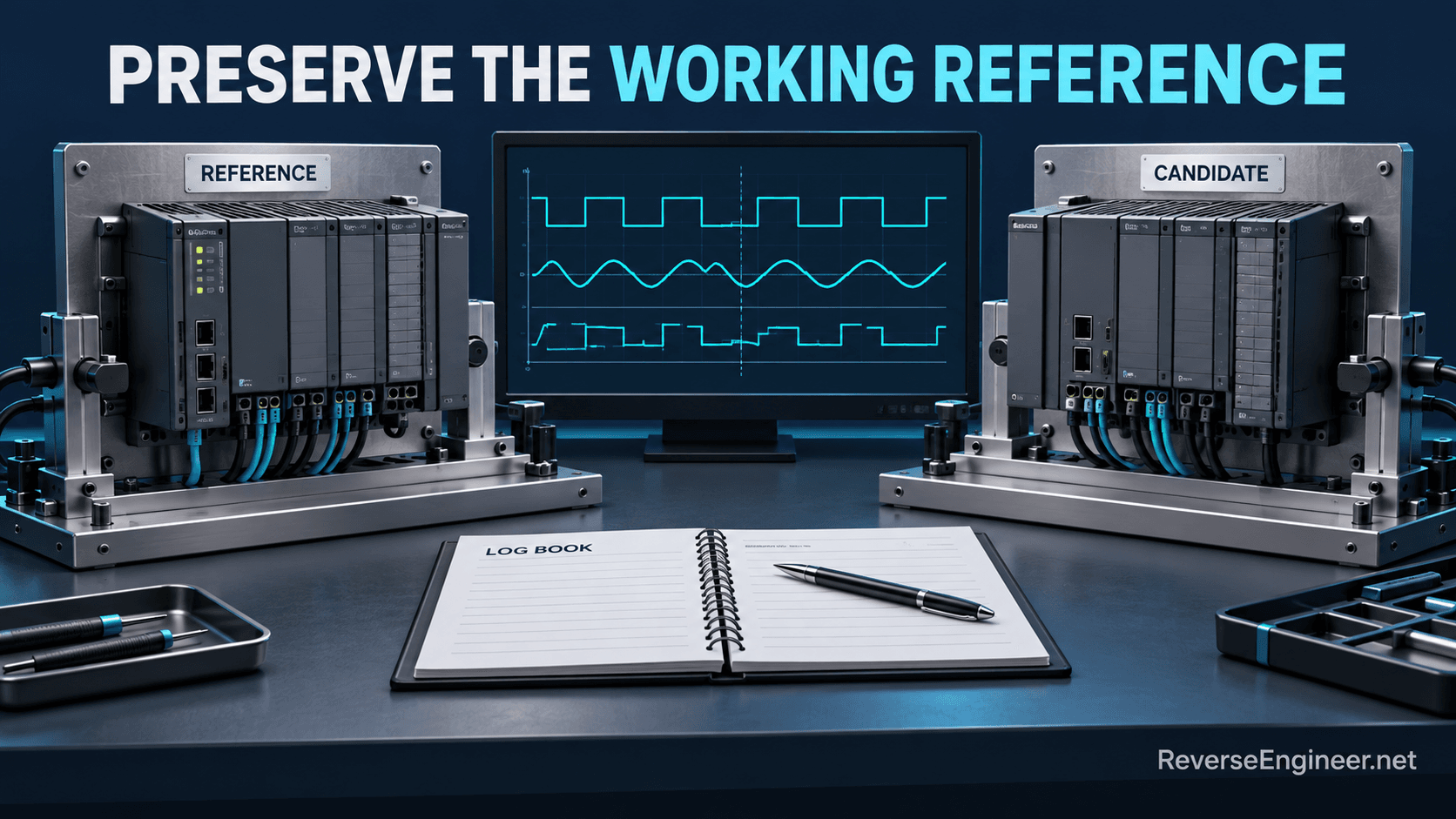
A controller that reproduces the expected output during one demonstration is not yet a verified replacement. Define input sequences, allowable tolerances, timing requirements and expected transitions. Compare the reference and candidate using the same stimuli and account for differences caused by hardware, calibration or measurement uncertainty.
Testing should include the operational edge cases that matter to the product: invalid inputs, communication loss, interrupted operation and restoration of persistent settings. The acceptance plan must state which conditions were exercised and which remain outside the evidence. For machinery with protective functions, the product’s responsible engineering team must include those functions in the wider validation process.
What the recovery project should deliver
A useful handover includes an indexed evidence set, architecture notes, recovered interfaces, a description of important states and a record of unresolved assumptions. Depending on scope, it can also include a maintained implementation, migration utility, test harness and instructions for reproducing the agreed checks.
Ownership of the new engineering assets matters. Define which scripts, specifications and source files the customer receives, what toolchain is needed, and how a future engineer can repeat the work. This prevents the recovery project from creating another unsupported dependency.
Scope the unknowns before scheduling a replacement
Feasibility depends on readable firmware, access to representative hardware and enough reference behaviour to define correctness. An encrypted image, missing external memory or a controller that no longer operates can change the approach. These are discovery questions to resolve early, rather than assumptions to hide inside a fixed implementation estimate.
Through our firmware reverse engineering services, we can discuss a staged scope: evidence review, targeted analysis, implementation and validation. The first stage should produce a decision the business can use, even if a complete rebuild is not the preferred route.
Discuss your unsupported controller
Contact ReverseEngineer.net with the controller family, available binaries, source-code status, hardware availability and the change you need to achieve. Include the functions that must remain compatible and the intended service life. That information provides a stronger starting point than a firmware file alone.
Let's Work Together
Working on an ECU, a firmware image, or a board? Send what you have.